
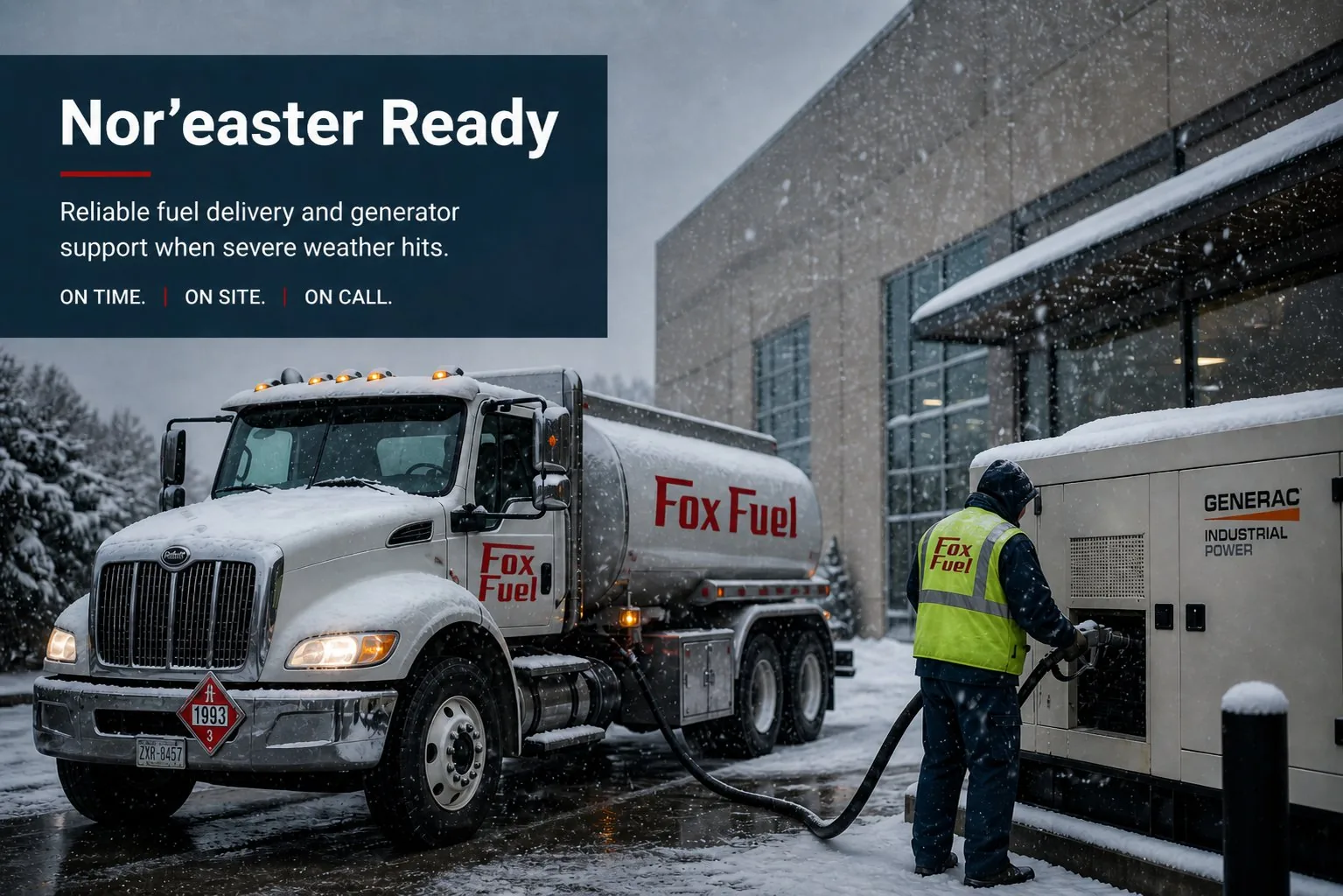
A nor'easter is the stress test your backup power system did not ask for. Grid outages that last 12, 24, or 48 hours put generator fuel consumption in a different category than the monthly 30-minute exercise run. Most facilities that experience a runout during a storm had enough fuel at the start. They ran out because nobody did the math on how long it would actually last.
Pre-storm checklist
- Check generator fuel level at least 72 hours before forecast storm arrival
- Top off any tank below 75% before storm conditions make delivery difficult or impossible
- Confirm tank monitor alerts are active and routed to someone who will be on-call during the storm
- Verify fill port access is clear and will remain accessible through snowfall
- Have your fuel supplier's after-hours dispatch number posted in the mechanical room
The math on generator burn rates
The number printed on a generator nameplate is maximum output in kilowatts, not fuel consumption. Actual fuel use depends on load - what percentage of that maximum the generator is actually running. Most facilities do not run at 100% load during a grid outage; a realistic figure is 50-75% for a typical commercial building.
A common rule of thumb for diesel generators is approximately 0.4 gallons per hour per 10 kW of load. A 100 kW generator running at 75% load (75 kW effective) burns roughly 3 gallons per hour. Here is how that plays out:
| Generator Size | Load % | Approx. Burn Rate | Hours from 500 gal tank |
|---|---|---|---|
| 100 kW | 50% | 2 gal/hr | 250 hours |
| 100 kW | 75% | 3 gal/hr | 167 hours |
| 250 kW | 50% | 5 gal/hr | 100 hours |
| 250 kW | 75% | 7.5 gal/hr | 67 hours |
| 500 kW | 75% | 15 gal/hr | 33 hours |
To run this calculation for your generator: find the full-load fuel consumption rate in your generator's spec sheet (usually listed in gallons per hour at 100% load). Multiply by your expected load percentage. That is your burn rate. Divide your usable tank volume by the burn rate to get your runtime in hours. Note that usable tank volume is not the full tank capacity - most tanks have a heel that cannot be drawn. Use the usable figure, not the nameplate capacity.
Run this math before every major storm forecast. If the answer is less than 72 hours, top off.
Monitoring during an active outage
If the grid goes down and the generator starts, begin monitoring fuel level on a schedule rather than waiting for an alert. Check every 4-6 hours on tanks without automated monitoring. Compare actual consumption against the burn rate calculation. If consumption is running higher than expected, revise the runtime estimate and call dispatch earlier than you think you need to.
The threshold to call is 40% tank level, not 20%. A 40% call gives dispatch time to route a truck and complete the fill before conditions deteriorate. A 20% call during an active storm, with multiple facilities calling simultaneously, may not result in a delivery before you hit empty.
What to do if dispatch cannot reach you
During a major regional storm, communication can get complicated. Cell networks load up, office phones may be down, and the person listed as the site contact may not be reachable. Here is how to set the account up to function even if the primary contact is unavailable:
- List a secondary contact on your account. Most suppliers allow this. It should be someone who will be accessible during a storm - not a daytime-only office number.
- Use tank monitoring with direct dispatch integration. A monitored tank triggers a reorder automatically when it hits the low-level threshold, without requiring a phone call from anyone on your team.
- Leave physical access instructions that do not require a person on-site. If the fill port is accessible and the driver can complete the delivery without an escort, that delivery can happen at 3 AM without waking anyone up.
- Confirm gate code and access details with your supplier before storm season. Drivers cannot fill tanks they cannot reach. Make sure the access information on file with your supplier is current every fall.
If a delivery attempt fails because dispatch could not reach the site contact and there was no secondary, that runout is preventable. The infrastructure to avoid it takes about 10 minutes to set up.
Related Resources
Questions about fuel delivery for your facility?
Call (215) 659-1616 or get a quote online. Fox Fuel serves commercial accounts across Pennsylvania and New Jersey from our Willow Grove location - family-owned since 1981.