
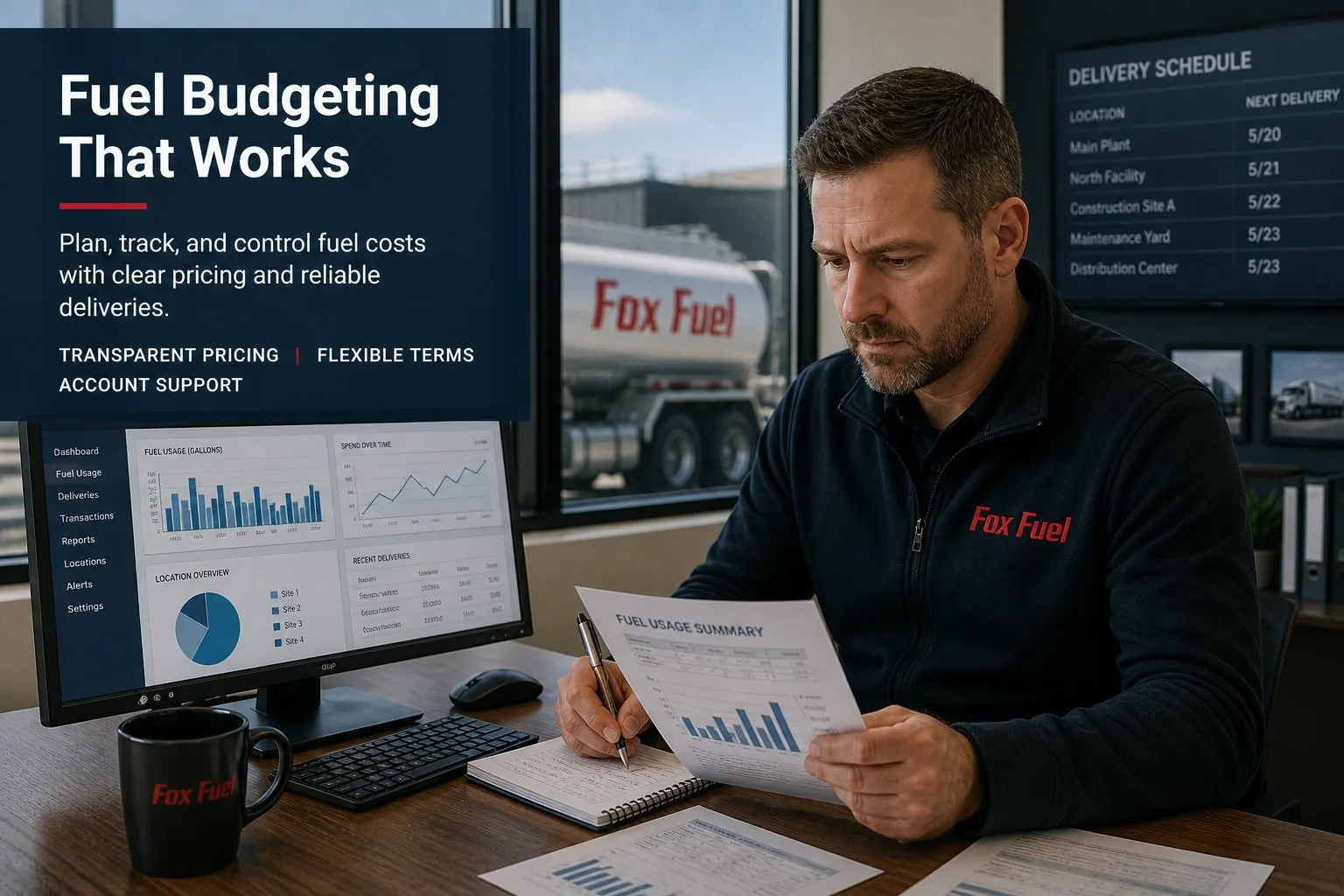
Every facility manager who has presented a fuel budget to a board knows the problem: last year's number is wrong, this year's weather is unpredictable, and "we'll adjust mid-year" is not a plan. A defensible fuel budget is built on normalized data, not last winter's actuals. Here is how to build one that holds up.
Start with normalized historical consumption
Gather three years of delivery tickets and calculate total gallons delivered, total heating degree days from NOAA data, and gallons per degree day (K-factor). The K-factor typically remains constant year to year unless building changes occur. Rising K-factors indicate potential issues: increased occupancy, boiler efficiency decline, envelope deterioration, or measurement problems.
Project next year's gallons
Multiply normal-year degree days (typically a 30-year NOAA average) by the current K-factor. This formula produces a weather-normalized consumption forecast more reliable than using actual prior-year gallons, which may reflect atypical weather patterns.
Layer in pricing assumptions
Commercial heating oil pricing follows crude and distillate markets. Three budgeting approaches exist:
- Conservative: Use the higher of current market price or the 12-month trailing average
- Neutral: Apply the 6-month trailing average
- Aggressive: Use current market price
Pricing structures include fixed-price contracts, floating/market-based pricing, and cap-and-collar arrangements. Each presents distinct trade-offs between budget certainty and market exposure.
Add reserve for weather and emergency
Budget additions should account for extreme cold scenarios (10-20% consumption increases), emergency fills (2-5%), and delivery frequency changes. A reasonable reserve totals 10-15% above weather-normalized projections.
Include non-fuel line items
Comprehensive budgets should itemize tank monitoring fees, fuel polishing services, emergency surcharges, fuel quality analyses, tank inspections, and administrative documentation costs.
Building the budget document
A defensible budget includes: historical context (three years of data), normalized consumption forecasts, pricing assumptions with sources, itemized costs, total projected spending, sensitivity analysis at various price and temperature points, and contingency plans.
What boards want to see
Organizations want weather-normalized historical comparison and explicit pricing assumptions with sources rather than simplified year-over-year adjustments. Present the sensitivity table - boards ask about it anyway. Give them the answer before the question.
Mid-year budget monitoring
Compare actual versus projected year-to-date gallons and degree days. Investigate variances exceeding 10% and revise forecasts accordingly.
When to revise
Revision triggers include temperature extremes outside sensitivity ranges, major pricing fluctuations, building usage changes, or supply disruptions.
Related Resources
Questions about fuel delivery for your facility?
Call (215) 659-1616 or get a quote online. Fox Fuel serves commercial accounts across Pennsylvania and New Jersey from our Willow Grove location - family-owned since 1981.